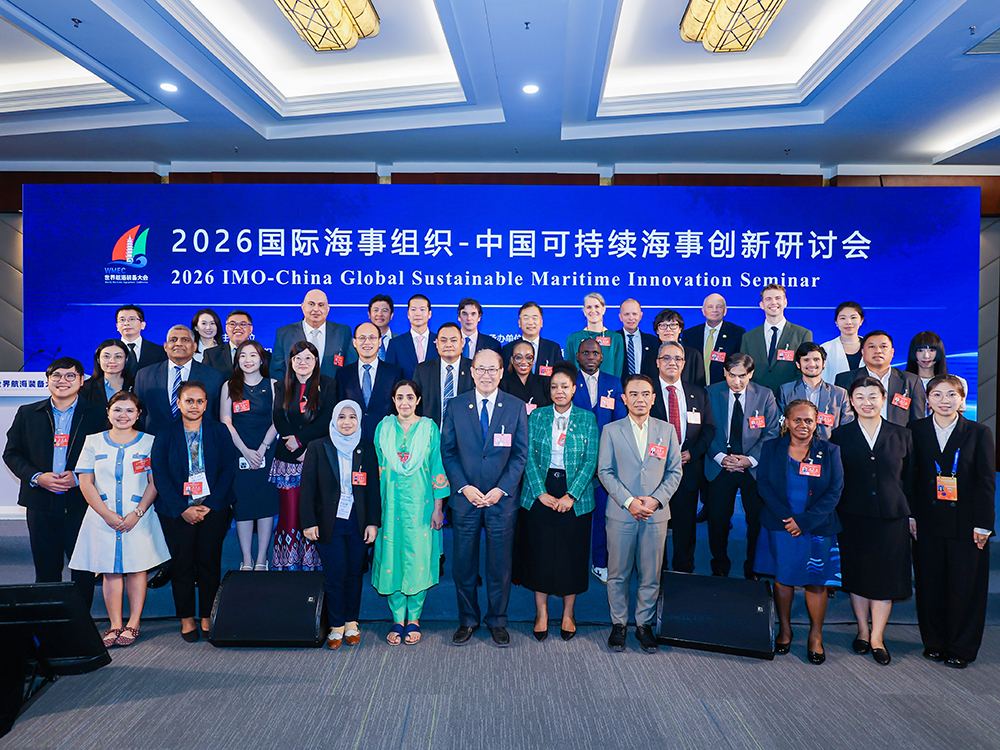
The 2026 IMO-China Global Sustainable Maritime Innovation Seminar, held in Fuzhou, China (16 October) brought together representatives of Member States, intergovernmental and non-governmental organizations, industry and academia to exchange views on innovation and capacity development in support of sustainable shipping.
The Seminar reviewed progress under a cooperation framework introduced by China in 2025 to contribute to the implementation of IMO’s Capacity-Development Strategy. The framework covers green shipping, smart shipping and digitalization, port sustainability, and maritime policy and implementation, with particular attention to the needs of developing countries, including small island developing States (SIDS) and least developed countries (LDCs).
A thematic panel discussed how green and digital transformation can be advanced together across ships, ports and the wider maritime sector, and how experience and technologies can be shared with developing countries.
Such experiences are outlined in two publications launched during the seminar: the first editions of the "Maritime Innovation Good Practices", a compilation of replicable cases on ship and port technology, maritime logistics and policy innovation; and the "Maritime Innovation Brief", a collection of forward-looking studies contributed by partner institutions.
A dedicated session during the Seminar featured the first cohort of the Maritime Innovation Leadership Programme, funded by China, which brought together 20 participants from 17 countries to develop implementable maritime projects. Participants undertake a 10-day course in Ningbo, Fuzhou and Shanghai in China, combining lectures, field visits, mentoring, simulation, attending an equipment expo and final presentations.
The Seminar was co-hosted by IMO, the China Maritime Safety Administration (China MSA) and the Global Sustainable Transport Innovation and Knowledge Center (GSTIKC), with the support of the Fuzhou Municipal People’s Government.
The session was opened by Mr. Shen Hao, Deputy Director General of China MSA, who delivered a statement from Dr. Jose Matheickal, Director of IMO’s Technical Cooperation and Implementation Division, which highlighted the role of partnerships and knowledge-sharing in translating the Capacity-Development Strategy into practical support for Member States. Participants also heard from Mr. Kitack Lim, former Secretary-General of IMO, and from senior representatives of partner organizations, including IALA, the International Chamber of Shipping and the Danish Maritime Authority.
Looking ahead
A roundtable held on 17 October reviewed the outcomes of the Seminar and considered priorities for 2027, including new editions of the knowledge products and a further cycle of the Leadership Programme. Member States and partners interested in getting involved in the programme are invited to contact GSTIKC (xin_jin@gstikc.org.cn).