Maritime officials in Ecuador have agreed to set up a national information network, connecting ports, ship operators and environmental authorities to help tackle biofouling - the unwanted accumulation of aquatic organisms on ships’ hulls.
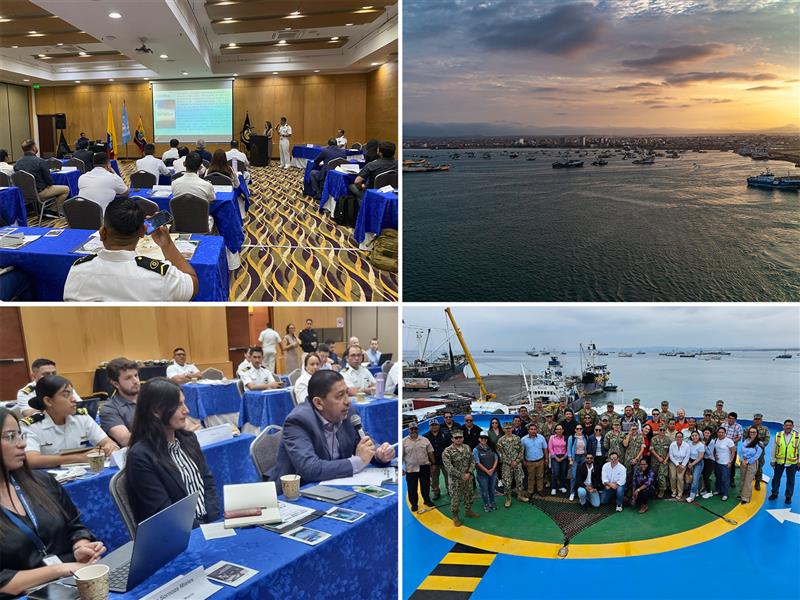
The initiative is one of several key outcomes of a recent workshop delivered by the International Maritime Organization (IMO) in collaboration with the Maritime Technology Cooperation Centre Caribbean (MTCC Caribbean) and the Armada del Ecuador, held in Manta, Ecuador (1–3 October).
The workshop was delivered as part of the IMO–Norad TEST Biofouling Project - a global initiative aimed at supporting developing countries in strengthening their capacity to manage biofouling, prevent the transfer of invasive aquatic species (IAS), and reduce greenhouse gas (GHG) emissions from ships.
The IMO–Norad TEST Biofouling National Demonstration Pilot Workshop saw renewed commitment among maritime authorities, port administrations, research institutions, and industry stakeholders to work more closely together to promote environmentally sound biofouling management practices aligned with IMO’s Biofouling Guidelines.
Discussions reinforced the links between biofouling management, energy efficiency, and GHG emissions reduction from ships, while highlighting the role of women and young professionals in sustainable maritime governance.
As one of the Project’s Lead Partnering Countries (LPCs), Ecuador plays a central role in advancing regional collaboration and demonstrating practical, technology-driven approaches to sustainable biofouling management.
Over three days, participants received hands-on training in biofouling risk assessment and in-water inspection methodologies. The final day featured a live demonstration by Franmarine at the Terminal Portuario de Manta, showcasing advanced Remotely Operated Vehicles (ROVs) for hull inspection and environmentally friendly cleaning.
MTCC Caribbean and IMO will continue to support capacity development and knowledge-sharing as Ecuador explores next steps, ensuring lessons from the demonstration are incorporated into future capacity-building initiatives.
Ecuador previously hosted an international workshop, co-organised by IMO’s GloFouling Partnerships Project, in the Galapagos Islands - home to some of the world's most uniquely endemic wildlife species - which focused on preventing the spread of invasive aquatic species in Marine Protected Areas (MPAs) and Particularly Sensitive Sea Areas (PSSAs).